Introduction to Portfolio Epics in Lean Portfolio Management
Portfolio epics are large, strategic initiatives that require significant investment and coordination across multiple teams in a Lean-Agile organization. They are not simple user stories or small features; instead, they represent enterprise-level change that directly supports long-term business goals. These epics reflect what an organization hopes to accomplish at the highest portfolio tier and help steer the direction of product development, capability building, or transformative change. Because of their large scope, managing the flow of portfolio epics requires structured governance, continuous alignment, and effective prioritization.
At the portfolio level, epics serve as the connective tissue between strategy and execution. They ensure that leadership defines value-driven outcomes and teams deliver them using clear roadmaps and predictable flow. Managing these epics effectively helps organizations maintain strategic clarity, reduce bottlenecks, and align investments with measurable results. In Lean Portfolio Management (LPM), this flow management depends heavily on visibility, feedback loops, and economic decision-making principles.
Understanding the Epic Lifecycle: From Ideation to Completion
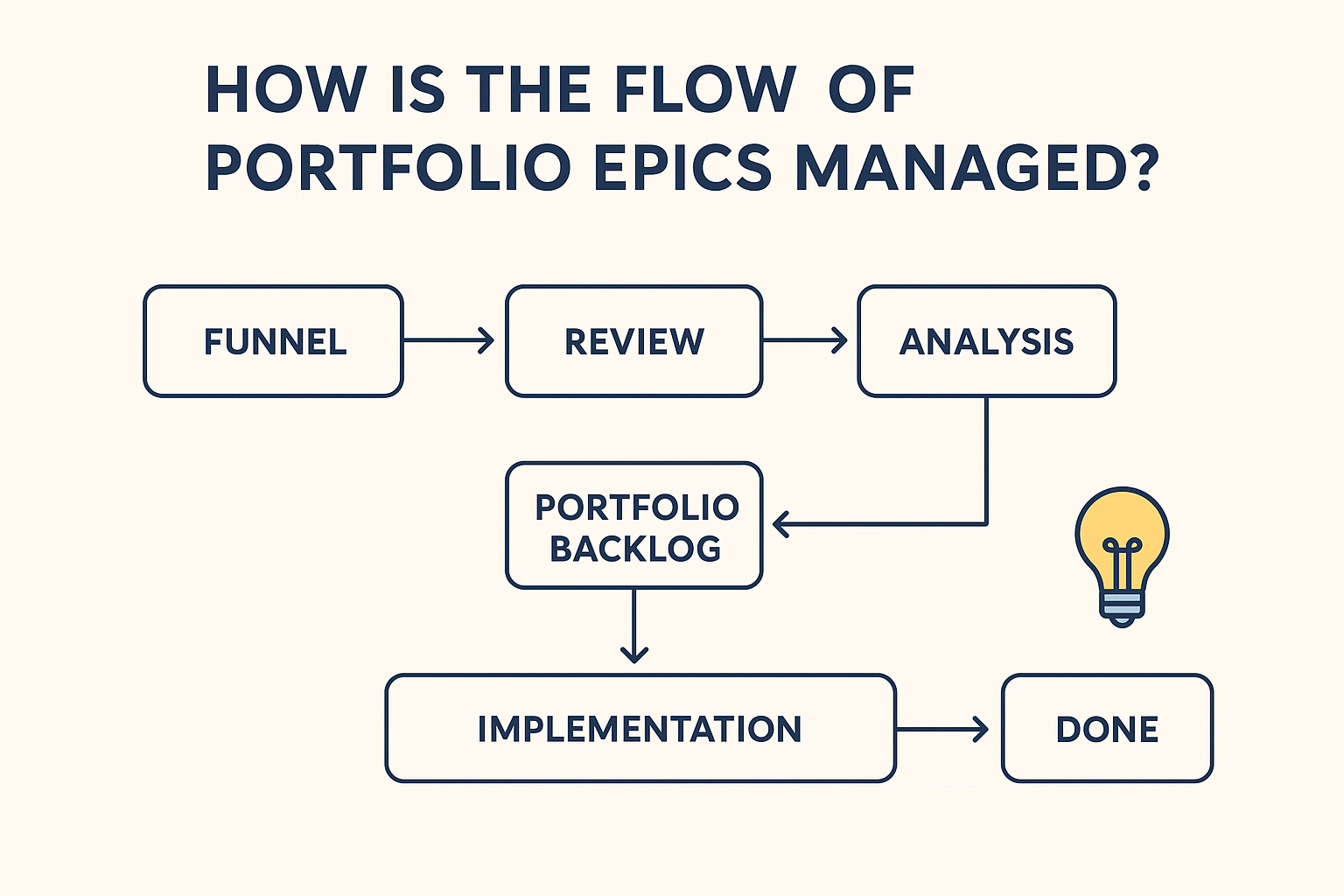
The flow of portfolio epics begins with ideation, where business owners, architects, or product leaders identify high-level opportunities or challenges. These opportunities undergo an initial review where they are roughly sized, validated for feasibility, and matched with strategic themes. Once an idea shows sufficient potential, it becomes a candidate epic that moves into a more structured analysis pipeline. This phase forms the backbone of effective portfolio planning because it ensures that only valuable and viable ideas progress further.
After initial evaluation, the epic enters a formal analysis stage where Lean business cases are created. This includes defining the problem, proposed solution, expected benefits, cost, and the KPIs that will measure success. Once approved, the epic moves into implementation, where Agile Release Trains (ARTs) deliver increments of value through Program Increments (PIs). The cycle completes when the epic achieves its intended value or is stopped if it proves non-viable or less beneficial than expected.
Epic Owners and Their Role in Managing Flow
Epic Owners play a critical role in managing the flow of portfolio epics by acting as the primary champions and coordinators for each initiative. They work closely with business owners, architects, and product managers to refine the epic’s scope, build the business case, and maintain alignment with strategic objectives. Their involvement ensures that epics are properly analyzed, split into smaller work items, and prioritized for implementation without losing sight of the overall vision. In many organizations, the effectiveness of epic flow largely depends on the discipline and oversight epic owners bring to the process.
Once implementation begins, Epic Owners continuously track progress to make sure the epic stays within its approved budget, timeline, and expected value outcomes. They monitor key metrics and work with ARTs or solution trains to remove blockers and maintain momentum. This active oversight helps maintain a steady flow of work through the portfolio system while enabling faster feedback. Effective Epic Owners know when to pivot, adjust scope, or even recommend stopping an epic if it no longer aligns with strategy or delivers sufficient value.
Using Kanban Systems to Manage Epic Flow
One of the most essential tools in managing the flow of portfolio epics is the Portfolio Kanban system. This visual workflow framework helps leadership and teams understand where each epic sits in its lifecycle—from ideation to completion. By making the status of epics transparent, organizations gain the ability to control work-in-progress (WIP), spot bottlenecks, and ensure that valuable initiatives are not delayed. The Kanban board typically includes stages like Funnel, Review, Analysis, Portfolio Backlog, Implementation, and Done.
Kanban also promotes a more predictable and sustainable flow of work by enforcing WIP limits. These limits prevent the portfolio from taking on too many epics at once, which could overwhelm teams and dilute focus. The visual nature of Kanban encourages ongoing collaboration and ensures decisions are made based on data rather than assumptions. This leads to faster time-to-market, better prioritization, and improved value delivery across the enterprise.
Prioritization and Weighted Shortest Job First (WSJF)
Managing the flow of portfolio epics also depends on a structured prioritization approach. The Weighted Shortest Job First (WSJF) technique is commonly used in Lean Portfolio Management to determine which epics should move forward first. WSJF considers factors like user value, time criticality, risk reduction, and job size to calculate a score. This scoring system helps leadership compare epics objectively instead of relying on intuition or gut feeling. As a result, higher-value, faster-to-deliver epics move through the flow more efficiently.
Applying WSJF ensures that the portfolio backlog remains aligned with strategic goals while enabling quicker wins. Prioritizing based on economic value creates a smoother and more predictable epic flow, reducing delays and maximizing ROI. It also saves the organization from spending resources on low-value initiatives that do not support long-term objectives. The continuous application of WSJF helps maintain a responsive and adaptive flow system across the portfolio.
Strategic Themes and Their Influence on Epic Flow
Strategic themes serve as the guiding compass for all portfolio-level decision-making. They represent enterprise goals and key focus areas for investment. When leadership consistently aligns epics with strategic themes, the flow becomes intentional rather than chaotic. This alignment ensures that every epic contributes to meaningful outcomes such as customer satisfaction, operational efficiency, technological modernization, or market expansion. Consequently, epic flow becomes a structured, strategy-driven process instead of scattered priorities.
Strategic themes influence prioritization, budget allocation, and decision-making throughout the entire lifecycle of portfolio epics. They help prevent misalignment, redundant efforts, and resource conflicts. By continually mapping each epic to a strategic theme, organizations maintain clarity and cohesion, enabling smoother execution. This focus creates a robust environment where epic flow supports the organization’s long-term vision.
Budgeting and Lean Governance in Managing Epic Flow
Lean governance plays a fundamental role in managing the flow of portfolio epics by ensuring that the allocation of funds supports high-value work. Instead of large, rigid annual budgets, Lean Portfolio Management encourages incremental and flexible funding approaches. This financial agility allows leaders to quickly shift funds between epics based on performance, strategic relevance, and changing market conditions. As a result, epic flow becomes more dynamic and responsive.
Lean governance also includes guardrails such as investment horizons, spending caps, and decentralized decision-making. These controls ensure that teams have enough autonomy to move fast without compromising financial accountability. With clear governance structures in place, epic implementation can proceed smoothly while maintaining alignment with strategic and economic constraints. This is how organizations prevent bottlenecks caused by funding delays or bureaucratic oversight.
Monitoring, Metrics & Feedback Loops
To maintain a healthy flow of portfolio epics, organizations must continuously monitor progress using flow metrics and performance indicators. Typical metrics include lead time, throughput, flow load, and flow efficiency. These metrics highlight how smoothly epics move through the system and where blockages occur. Metrics also help leadership understand whether teams are overloaded, whether priorities are shifting effectively, and how quickly value is delivered to the customer or business.
Feedback loops are equally important because they ensure that value delivery remains consistent with expectations. Regular strategic reviews, PI planning events, and inspect-and-adapt sessions help refine the flow of epics based on real-world insights. This continuous improvement mindset leads to a more agile, efficient portfolio system capable of adapting to change rapidly. With strong feedback loops, the flow of portfolio epics becomes a cycle of improvement rather than a rigid sequence of tasks.
Conclusion: Why Effective Epic Flow Management Matters
Managing the flow of portfolio epics is essential for any organization implementing Lean Portfolio Management. It ensures that strategic initiatives move efficiently from ideation to execution without unnecessary delays or wasted resources. By combining portfolio Kanban, WSJF prioritization, Lean governance, and continuous feedback, organizations can create a predictable and high-value flow. This improves time-to-market, strengthens strategic alignment, and boosts overall business agility.
Ultimately, effective epic flow management empowers teams to deliver transformational value that supports long-term growth. It enables leaders to make better decisions, create stronger alignment, and maintain a healthier portfolio pipeline. When organizations master this discipline, they gain the competitive edge needed to respond quickly to change and innovate with confidence.