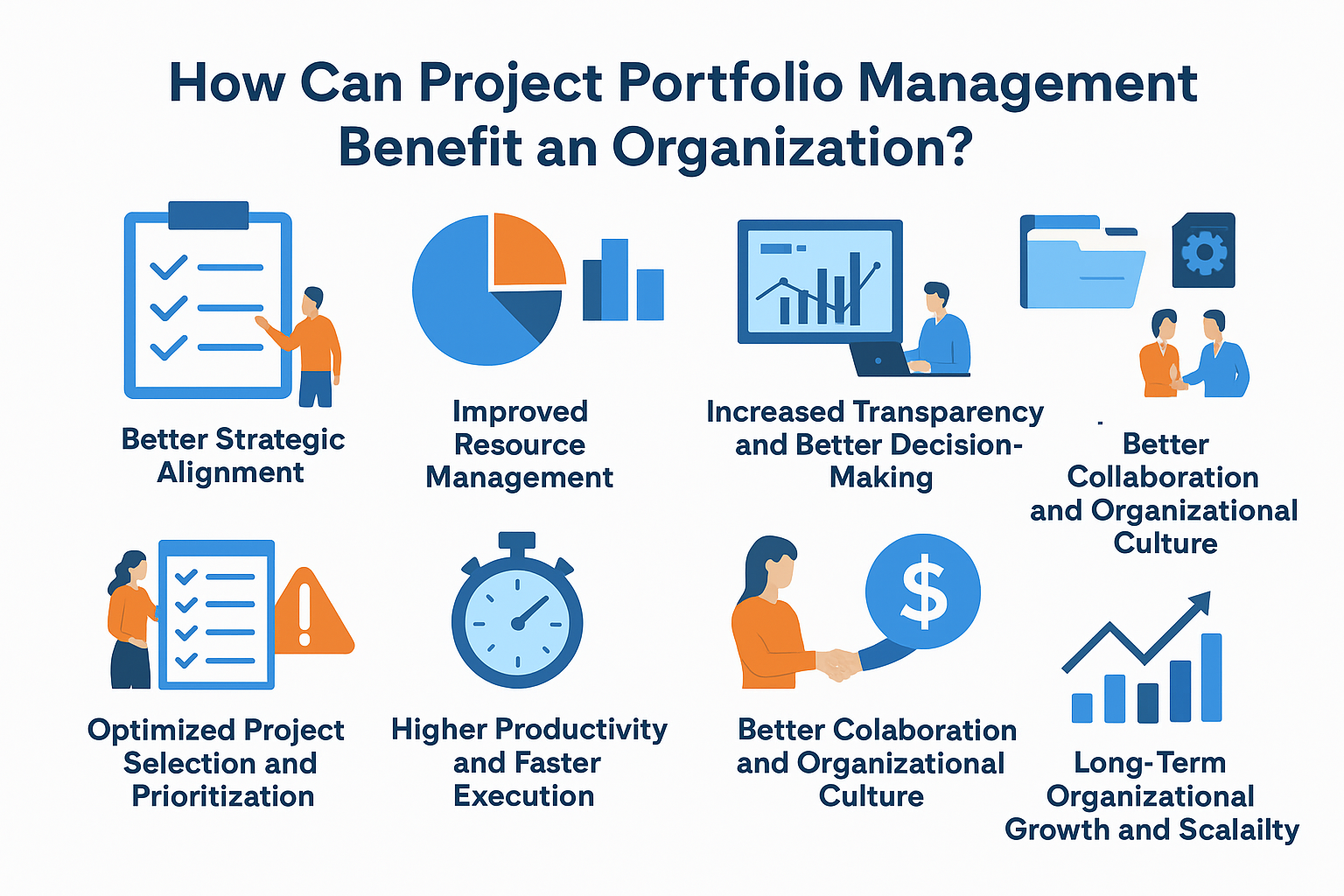
Project-based work has become the backbone of modern business, where every initiative consumes resources, demands attention, and influences long-term growth. But as organizations scale, the number of strategic projects also increases, often leading to confusion, misallocation of resources, and inconsistent outcomes. This is where understanding how can project portfolio management benefit an organization becomes essential. Project Portfolio Management (PPM) brings structure, visibility, and control to all projects, ensuring that teams work on what truly matters. It enables leaders to prioritize the right initiatives while eliminating low-value projects that drain time and money.
PPM is not just about managing multiple projects — it is about aligning every effort with your broader business goals. Instead of operating in silos, departments collaborate efficiently, decisions become data-driven, and results are more predictable. For companies looking to improve profitability, reduce risks, and optimize performance, PPM acts as a powerful strategic tool. In this guide, we break down its core benefits, real-world impact, and why organizations across industries are now implementing PPM systems.
1. Better Strategic Alignment
One of the biggest advantages of Project Portfolio Management is its ability to align projects with the organization’s strategic objectives. Many organizations struggle because teams initiate projects without evaluating whether they support long-term goals. With PPM, leaders can evaluate every project request based on business value, feasibility, and expected ROI. This ensures that the company invests time and money only in initiatives that drive growth or support critical functions.
When strategic alignment strengthens, decision-making also becomes easier. Organizations can quickly identify which projects contribute the most value and which should be delayed or discontinued. This not only saves money but also prevents teams from wasting energy on initiatives that do not matter. Through this structured approach, companies create a stronger roadmap and maintain clarity around future priorities.
2. Improved Resource Management
Resources — whether financial, human, or technological — are limited in every organization. Without a structured system, teams often find themselves overworked, underutilized, or misallocated. PPM gives organizations complete visibility into resource availability, skill sets, and workload distribution. Leaders can analyze how resources are being used and allocate them strategically to the highest-priority projects. This is a major way that how can project portfolio management benefit an organization, especially those with repetitive overload issues.
Better resource management reduces burnout, increases productivity, and ensures that skilled team members contribute where they can create maximum impact. PPM tools also help forecast resource requirements for future projects, allowing organizations to plan hiring or training ahead of time. By maintaining balanced workloads and preventing bottlenecks, organizations execute projects more smoothly and efficiently.
3. Enhanced Risk Management
Every project comes with uncertainties — budget overruns, delays, technical issues, or operational obstacles. When managing multiple projects, these risks can multiply quickly. PPM introduces a standardized approach to identifying, assessing, and mitigating risks across all initiatives. Leaders receive early visibility into potential threats, allowing them to take corrective actions before the problems escalate.
By consolidating risk data in one place, organizations develop a proactive culture rather than reacting to issues at the last minute. Teams can evaluate the risk impact on deadlines, financials, and resources, making decisions based on accurate forecasting. This leads to fewer project failures and better predictability, ultimately strengthening trust among stakeholders and clients.
4. Increased Transparency and Better Decision-Making
One of the top answers to how can project portfolio management benefit an organization is improved visibility. PPM provides real-time dashboards, performance metrics, and progress reports for all ongoing and planned projects. Leaders no longer rely on assumptions or fragmented information — instead, they get a clear picture of budgets, timelines, performance, and resource usage.
This level of transparency improves communication across departments and ensures that everyone stays informed. When leaders access accurate data, decisions become faster, smarter, and more strategic. Whether it’s continuing high-performing projects or pausing the ones falling behind, PPM supports data-driven decision-making at every stage.
5. Optimized Project Selection and Prioritization
Not all projects carry equal importance. Some drive revenue, others reduce operational costs, and a few support customer satisfaction or innovation. With PPM, organizations gain the ability to evaluate projects objectively based on value, urgency, ROI, risks, and alignment with strategy. This structured prioritization ensures that the most impactful initiatives receive the first share of resources.
As a result, organizations no longer run projects because “someone requested them” — they choose based on facts and clear evaluation criteria. This prevents waste, drives meaningful results, and strengthens the project execution culture. Better selection leads to better outcomes, and that ultimately improves overall performance across the organization.
6. Higher Productivity and Faster Execution
PPM creates a streamlined ecosystem where processes are standardized, projects follow defined workflows, and communication gaps are minimized. When teams know their responsibilities clearly and have access to the right tools, productivity naturally rises. Standardization also eliminates confusion, reduces duplication of work, and ensures consistency across all projects.
Faster execution becomes possible because PPM removes roadblocks early and keeps everyone aligned. When teams collaborate in a unified system, updates flow smoothly, and issues are resolved quicker. Organizations experience shorter project cycles, higher efficiency, and a better ability to adapt in a dynamic business environment.
7. Financial Control and Higher ROI
Financial clarity is another powerful benefit of PPM. Organizations can track project budgets, spending patterns, forecast future costs, and measure financial performance against expectations. This prevents overspending and allows leaders to redirect funds to the most valuable projects. Understanding how can project portfolio management benefit an organization from a financial perspective helps companies reduce losses and increase returns.
PPM also helps organizations measure ROI for every project. This visibility makes it easier to identify which initiatives provide the best outcomes, so future investments become more strategic. With better financial insights, companies strengthen fiscal discipline and long-term profitability.
8. Better Collaboration and Organizational Culture
PPM fosters a cooperative environment by bringing teams, departments, and stakeholders onto a single platform. Communication becomes clearer, updates are shared transparently, and expectations remain aligned. As a result, misunderstandings reduce, and the overall project culture becomes more collaborative.
When employees feel supported with the right information and systems, motivation increases. Teams work with confidence, knowing that their efforts contribute to organizational goals. The positive shift in culture improves productivity, innovation, and work satisfaction across the organization.
9. Long-Term Organizational Growth and Scalability
Finally, PPM helps organizations prepare for long-term growth. As companies expand, the number of projects multiplies, making traditional management methods ineffective. PPM ensures scalability by providing frameworks, tools, and governance structures to handle growth efficiently.
By mastering how to select, prioritize, and manage projects effectively, organizations become more resilient and competitive. They respond better to market changes, customer demands, and technological advancements. In the long run, PPM becomes a strategic asset that drives sustainable growth.
Conclusion
Understanding how can project portfolio management benefit an organization is crucial for leaders aiming to optimize performance, reduce risk, and support long-term success. From better strategic alignment to improved resource utilization, risk mitigation, and financial control, PPM delivers measurable value across every department.
Organizations that adopt Project Portfolio Management gain clarity, efficiency, and a stronger ability to meet their goals. In an increasingly competitive world, PPM is no longer optional — it is a necessity for businesses that aim to succeed and scale.