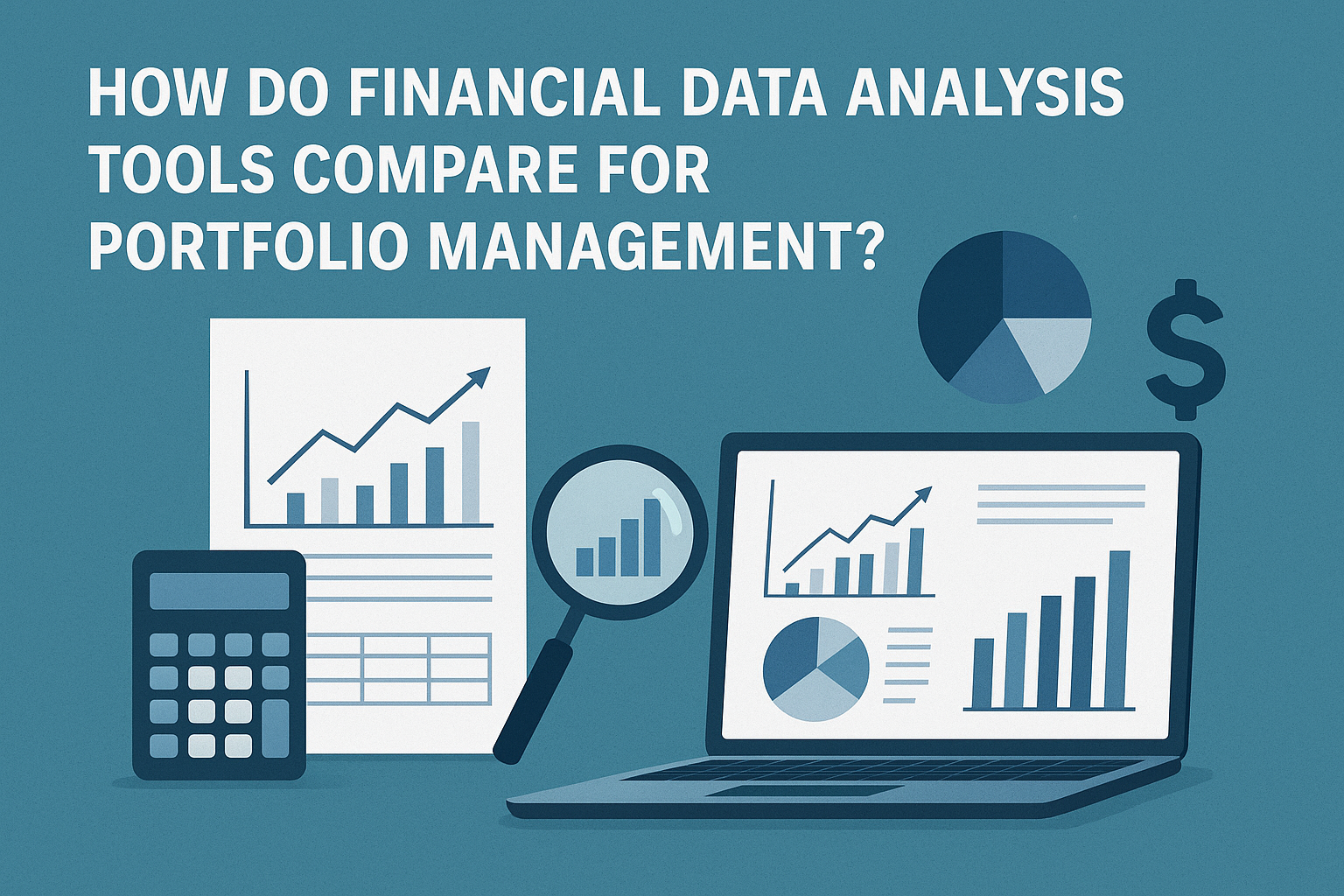
In today’s fast-paced investment environment, portfolio managers rely heavily on advanced financial data analysis tools to make informed decisions. From evaluating market trends to rebalancing asset allocations, these tools help investors enhance accuracy, reduce risks, and improve overall portfolio performance. But as new platforms enter the market and older ones evolve, one question becomes more important than ever: how do financial data analysis tools compare for portfolio management in real-world scenarios?
Understanding the differences between tools is crucial because each platform offers unique functionalities and benefits. Some are designed for deep quantitative analysis, while others focus on real-time data visualization, automation, or risk modelling. By comparing their strengths and limitations, investors can determine which tool aligns best with their strategy—whether they are active traders, long-term investors, or institutional managers.
Why Financial Data Analysis Tools Matter in Portfolio Management
Financial data analysis tools play a central role in modern investing by helping users interpret complex market data in a simplified, actionable format. These tools process large datasets, analyze historical trends, and identify patterns that human analysts might miss. As a result, portfolio managers gain a deeper understanding of market behavior, asset volatility, and potential investment opportunities. Without these tools, managing a diversified portfolio becomes time-consuming and prone to errors.
Moreover, robust analytics platforms enhance decision-making by providing real-time insights and automated alerts. Features like performance tracking, correlation analysis, and risk assessment allow investors to optimize their portfolios with greater precision. This is especially important as markets become more dynamic and unpredictable. Therefore, when exploring how do financial data analysis tools compare for portfolio management, it becomes clear that the right tool can significantly influence investment outcomes.
Key Features to Consider When Comparing Financial Data Tools
When evaluating how financial data analysis tools compare for portfolio management, it is essential to consider the core features that differentiate them. Most professional tools offer performance analytics, asset allocation dashboards, benchmarking capabilities, and risk metric calculations such as Value at Risk (VaR) or Sharpe ratios. These features help assess portfolio health and guide strategic decisions. Yet the depth, accuracy, and usability of these features vary widely across platforms.
Another important aspect is the integration capability. Some tools seamlessly connect with trading platforms, brokerage accounts, and market data feeds, ensuring all information updates automatically. Others require manual data uploads, which may slow down decision-making. Additionally, the quality of visualization tools—charts, heatmaps, forecasts, and correlation matrices—also affects how efficiently an investor can interpret data. Understanding these features helps users choose the tool that aligns best with their workflow.
Comparing Popular Financial Data Analysis Tools: Bloomberg vs. Morningstar
When discussing how do financial data analysis tools compare for portfolio management, Bloomberg is often the first name that comes to mind. Bloomberg Terminal is one of the most advanced tools in the industry, offering real-time market data, news updates, advanced charting tools, and in-depth analytics. It is widely used by institutional investors, hedge funds, and analysts who need high-frequency data and instant access to global financial markets. However, it comes with a high subscription cost, making it less accessible to individual investors.
On the other hand, Morningstar is known for its comprehensive research, mutual fund ratings, and portfolio management features. It is more cost-effective compared to Bloomberg and is widely used by financial advisors and retail investors. Morningstar’s strength lies in long-term investment analysis, asset evaluation, and risk assessment tools. While it may lack some of Bloomberg’s real-time capabilities, it remains a powerful choice for users focused on fundamental analysis and diversified portfolio management.
Comparing Quantitative-Focused Tools: MATLAB, R, and Python
For investors who prefer a quantitative approach, programming-based tools like MATLAB, R, and Python offer unmatched flexibility. MATLAB is widely used in academia and financial engineering due to its strong mathematical modelling environment and toolboxes for risk modelling, optimization, and forecasting. It allows portfolio managers to create customized algorithms and run complex simulations that go beyond the capabilities of standard portfolio software.
Meanwhile, R and Python have become increasingly popular due to their open-source nature and vast libraries. Python frameworks like Pandas, NumPy, and SciPy help quickly analyze data and build custom trading strategies, while R’s statistical packages excel in time-series analysis and econometric modelling. When analyzing how do financial data analysis tools compare for portfolio management from a quantitative perspective, these tools offer maximum customization but require programming skills to use effectively.
Comparing AI-Driven Tools: Kensho, AlphaSense, and TrendSpider
AI-powered analytics platforms are transforming how investors handle data. Kensho and AlphaSense use natural language processing (NLP) and machine learning to scan millions of documents—news articles, filings, earnings call transcripts—and extract actionable insights. These tools benefit portfolio managers by highlighting market-moving events, predicting trends, and identifying hidden risks before they become apparent. Their intelligence-driven insights make them a strong choice for research-heavy strategies.
TrendSpider, meanwhile, is popular among active traders for its automated charting, pattern recognition, and backtesting features. It uses AI to scan price movements, identify technical signals, and simplify trade planning. While not as research-focused as Kensho or AlphaSense, it excels in real-time market analysis and automated decision support. Together, these platforms show how AI reshapes how financial data analysis tools compare for portfolio management in the modern era.
How Risk Management Capabilities Vary Across Tools
Risk management is one of the most critical aspects of portfolio management, and tools vary significantly in how they handle it. Institutional-level platforms like Bloomberg, FactSet, and MSCI Barra provide sophisticated risk-metric calculations, stress testing, scenario analysis, and predictive modelling. These platforms help portfolio managers understand how macroeconomic events, sector movements, or inflation pressures may impact returns. Their depth makes them indispensable for hedge funds and asset management firms.
Retail-level tools, such as Personal Capital, M1 Finance, or even Morningstar, offer simpler risk assessment features. These may include risk scoring, diversification analysis, and volatility projections. While suitable for long-term investors, they may not meet the requirements of high-frequency traders or institutions that need advanced risk computations. Understanding these differences is essential when analyzing how do financial data analysis tools compare for portfolio management from a risk-management standpoint.
How Automation and Integration Influence Tool Comparison
Automation has become a key factor in comparing financial data analysis tools. Some platforms, such as Portfolio Visualizer or TrendSpider, offer backtesting capabilities, automated rebalancing, and strategy optimization. Automation reduces manual workload and helps investors stay disciplined by following predefined investment rules. These tools are ideal for investors who prefer systematic strategies rather than emotional decision-making.
Integration is equally important. Tools that connect with APIs, brokerage accounts, trading bots, or data feeds offer a seamless experience. For example, Python and R can integrate with almost any data source, while platforms like Bloomberg integrate with Excel, allowing customized models through Excel add-ins. The more integrated a tool is, the easier it becomes to manage complex portfolios. This greatly influences the answer to how do financial data analysis tools compare for portfolio management.
Choosing the Right Tool Based on Investor Type
The best financial data analysis tool depends on the investor’s style, goals, and expertise. Institutional investors or hedge funds may prefer platforms like Bloomberg, FactSet, or MSCI due to their advanced analytics and comprehensive global data. These tools support high-level modelling, risk assessment, and cross-asset analysis needed for large portfolios. However, they are expensive and may require professional training.
Individual investors or financial advisors may opt for Morningstar, Portfolio Visualizer, or Personal Capital, which simplify data interpretation and focus on long-term wealth building. Meanwhile, quantitative analysts and algorithmic traders might lean towards Python, MATLAB, or R because of their flexibility in creating custom strategies. The key is to match the tool’s strengths to the investor’s strategy, which is crucial in understanding how do financial data analysis tools compare for portfolio management.
Conclusion
When evaluating how do financial data analysis tools compare for portfolio management, it becomes clear that no single platform is perfect for everyone. Each tool varies based on capabilities, cost, complexity, and target users. Some excel in real-time analytics, while others shine in quantitative modelling, long-term research, or automated trading. The ideal choice depends on whether an investor values speed, customization, risk modelling, or user-friendly design.
In a world where market volatility is increasing and data is more abundant than ever, choosing the right financial data analysis tool can dramatically impact investment success. By understanding the strengths and limitations of each platform, investors can build a more informed, disciplined, and optimized portfolio strategy. Ultimately, the comparison helps investors select the tool that aligns with their goals and maximizes their long-term returns.