Introduction: Why SMA Portfolio Manager Architecture Matters
Architecting an SMA (Separately Managed Account) portfolio manager application is a mission-critical task for any fintech business dealing with personalized investment strategies. Unlike traditional pooled investment platforms, SMA systems must handle individualized client portfolios, real-time asset allocation adjustments, compliance checks, and reporting workflows tailored per investor. Because of this complexity, the architecture must prioritize scalability, accuracy, and regulatory alignment from day one. So understanding how to architect an SMA portfolio manager application becomes essential for building a reliable, compliant, and high-performance investment management product.
To deliver a smooth experience to portfolio managers, advisors, and end clients, the architecture must seamlessly integrate multiple layers—data ingestion, portfolio analytics, order execution, risk engines, and user-facing dashboards. Each layer must work independently yet communicate flawlessly through event-driven or API-based pipelines. The goal is to create a system that not only automates complex manual processes but also supports the dynamic nature of modern investment decisions. By the end of this guide, you will have a clear roadmap for designing a scalable SMA platform capable of handling thousands of personalized portfolios simultaneously.
Understanding SMA Portfolio Management Requirements
Before learning how to architect an SMA portfolio manager application, it’s essential to understand the core requirements that shape the design. SMA platforms must support individualized portfolio construction, client-specific mandates, tax optimization rules, and advisor-driven rebalancing workflows. Every portfolio may have unique restrictions, such as ESG exclusions, asset allocation models, sector caps, or risk thresholds. These constraints create a deeply personalized environment where automation must be both flexible and precise. Also, the application must handle multiple asset classes—equities, fixed income, ETFs, derivatives, and structured products—while maintaining accurate market data feeds.
Another critical requirement is regulatory compliance. SMA platforms must align with standards such as SEC regulations, MiFID II, KYC/AML rules, and firm-level compliance policies. The architecture must include audit logs, permissions, trade approvals, and data retention procedures. Performance reporting, tax-lot accounting, cash management, and after-trade reconciliation are also essential features that influence architectural decisions. When you fully understand these requirements, you can design a system that is not only robust and scalable but also ready for long-term regulatory and operational demands.
Core Architectural Principles for an SMA Application
When designing how to architect an SMA portfolio manager application, you must follow core architectural principles such as modularity, scalability, security, resilience, and high availability. A modular design helps separate critical components like order management, portfolio accounting, and risk analytics, ensuring that developers can update or scale any part independently. Scalability is equally important because SMA platforms must handle thousands of trading decisions, tax-lot calculations, and real-time data events without performance issues. Microservices or domain-driven design approaches make it easier to adapt to growing workloads over time.
Security is another non-negotiable principle. The application will deal with highly sensitive financial data, requiring encryption at rest and in transit, role-based access control (RBAC), multi-factor authentication, and secure APIs. Resilience is achieved through load balancing, failover nodes, database redundancy, and event-driven queues that buffer high-volume workflows. These principles ensure the system remains operational even during unexpected failures. By embedding these architectural fundamentals into your design, you set the foundation for a powerful SMA portfolio manager platform capable of supporting modern investment operations.
Key Components of an SMA Portfolio Manager Application
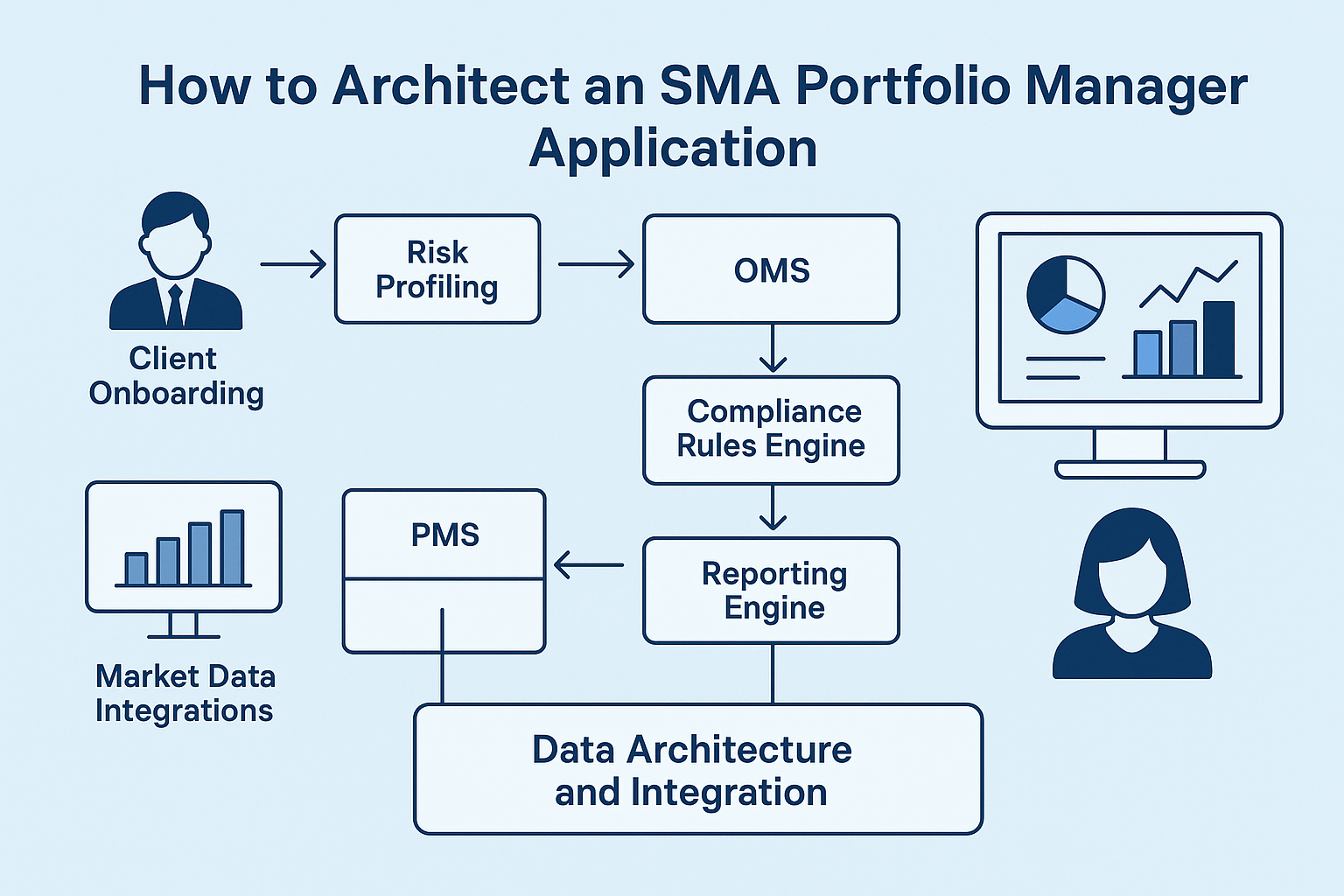
An SMA portfolio management system relies on several interconnected components that form the backbone of the architecture. The most important modules include client onboarding, risk profiling, portfolio construction, OMS (Order Management System), PMS (Portfolio Management System), compliance rules engine, reporting engine, and market data integrations. Each module must be built as a loosely coupled service to ensure easy maintenance and scaling. For example, the order management system should be able to operate independently even if the analytics engine undergoes updates or enhancements.
In addition to the core components, advanced SMA applications include AI-based recommendation engines, automated rebalancing tools, tax-loss harvesting modules, and real-time performance dashboards. These features help advisors provide tailored investment experiences while reducing manual workloads. Communication between these modules typically happens using REST APIs, GraphQL, message queues (Kafka/RabbitMQ), or event-driven microservices. The combination of these components ensures the SMA platform performs efficiently while delivering personalized and compliant portfolio management for each investor.
Data Architecture and Integration Strategy
Data is at the center of how to architect an SMA portfolio manager application, making data architecture one of the most important aspects of the design. SMA systems must handle enormous volumes of structured and unstructured data, including market feeds, portfolio holdings, trade confirmations, benchmark indices, and regulatory documents. A well-designed data pipeline ensures that the system always has clean, accurate, and real-time data. Using a combination of OLTP for transactional data and OLAP for analytics helps maintain performance across different workloads. Data lakes may also be used for storing historical data and generating insights through machine learning models.
Integrations are equally critical because SMA platforms depend heavily on external systems such as custodians, brokers, exchanges, pricing providers, and CRM systems. These integrations need secure APIs, webhook endpoints, or FIX protocol connections to ensure smooth and reliable communication. Using message brokers ensures that data flows seamlessly and avoids failures during high-volume trading periods. A robust integration layer also simplifies onboarding new data partners and custodians in the future. Ultimately, a strong data architecture forms the backbone of a scalable SMA platform.
Designing the Portfolio Accounting and Performance Engine
The portfolio accounting engine is the heart of an SMA system. It maintains tax lots, buying power, realized/unrealized gains, corporate actions, dividends, and other portfolio events. Because every SMA account can have unique investment history and rules, the accounting engine must support multi-currency portfolios, FIFO/LIFO accounting methods, and customized reporting periods. A well-architected system ensures that calculations remain accurate even during corporate actions or extreme market volatility. The performance engine, on the other hand, computes time-weighted and money-weighted returns, benchmark comparisons, risk metrics, and attribution analysis.
These calculations must be real-time or near real-time to support advisor dashboards and portfolio monitoring tools. Therefore, the engine should be optimized for fast computation using caching strategies, in-memory databases, or parallel processing. Having the accounting engine modular ensures scalability and accuracy as the number of SMA accounts grows. Ultimately, a robust accounting and performance engine strengthens portfolio transparency, improves reporting accuracy, and builds trust between advisors and investors.
Compliance, Risk, and Rebalancing Workflows
Compliance plays a central role in determining how to architect an SMA portfolio manager application, especially due to diverse restrictions across accounts. The application must validate every trade and portfolio adjustment against client-specific constraints such as sector limits, ESG exclusions, liquidity thresholds, and regulatory rules. A compliance engine that uses rule-based logic, policy templates, and real-time alerts ensures that any breach is caught before execution. This reduces operational risk and enhances the platform’s reliability. Risk engines calculate portfolio volatility, drawdowns, beta, VaR, and exposure metrics to guide advisors in making informed decisions.
Rebalancing is another key workflow in SMA systems. Advisors often need to run bulk rebalancing for hundreds of clients while still respecting individual constraints. Automating the rebalancing process requires algorithms that propose optimal trades while minimizing tax impact and trading costs. Once the trades are approved, they are routed to the order management system for execution. Designing these workflows efficiently ensures that the platform maintains portfolio accuracy, aligns with mandates, and improves portfolio management productivity.
Building the User Interface and Experience
A modern SMA portfolio manager application needs a high-quality user interface that simplifies complex financial data while remaining intuitive for users. Advisors should be able to see portfolio summaries, allocation charts, performance metrics, alerts, and rebalancing suggestions in a clean and organized dashboard. Clients, on the other hand, may only need basic portfolio overviews, statements, and performance reports. Designing role-based user interfaces helps personalize the experience and reduce information overload for end users.
The front end must seamlessly communicate with backend services using APIs or real-time WebSocket connections. Implementing responsive design ensures the platform works across desktops, tablets, and mobile devices—important for advisors who need quick insights on the go. Visualizations using libraries like D3.js or Highcharts help transform complex analytics into readable charts. A strong UI/UX layer enhances the platform’s usability and contributes significantly to user satisfaction.
Security Architecture and Regulatory Compliance
Security is one of the most critical aspects when planning how to architect an SMA portfolio manager application. Since the platform handles financial data, identity documents, trading details, and personal information, it must follow strict security protocols. These include encryption (AES-256, TLS), secure API gateways, intrusion detection systems, and regular penetration testing. Role-based access ensures that users only see the data relevant to their authority. Tokenized authentication, MFA, and behavioral monitoring further enhance platform safety.
From a compliance standpoint, the application must support audit logs, secure data trails, GDPR compliance, and real-time reporting for regulatory filings. Backup strategies, disaster recovery plans, and data retention policies must also be integrated into the architecture. By embedding security and compliance into every layer of the application, you protect the platform from cyber risks and ensure it meets global regulatory expectations across jurisdictions.
Conclusion: Bringing Your SMA Architecture to Life
Understanding how to architect an SMA portfolio manager application requires a blend of financial domain knowledge, technical expertise, and regulatory awareness. From modular architecture and scalable microservices to robust accounting engines and compliance workflows, each part plays a major role in ensuring the system performs efficiently. SMA platforms require extreme accuracy and personalization, which is why the architecture must be flexible enough to adapt to diverse investor mandates and market changes.
By following the design principles and architectural strategies discussed in this guide, you can create an SMA application that is not only operationally strong but also future-ready. Whether your goal is to support advisors, automate trading workflows, or deliver customized portfolio insights to clients, the architecture becomes the backbone of your long-term success. Build it right, and your SMA platform will scale smoothly and deliver exceptional value to users for years to come.