Introduction: Understanding Private Credit and Its Growing Importance
Private credit has emerged as one of the fastest-growing asset classes in global finance, attracting institutional investors, high-net-worth individuals, family offices, and even retail investors through structured products. Unlike traditional lending done by banks, private credit involves non-bank lenders—such as private credit funds, asset managers, and direct lenders—providing loans to businesses. As the demand for flexible capital increases, so does the importance of understanding who manages risk and return in private credit portfolios. Effective risk management ensures that investors receive stable returns while controlling exposure to credit defaults, market volatility, and liquidity challenges.
Since private credit often focuses on middle-market companies and borrowers who may not have access to traditional bank financing, the risks are naturally different and sometimes higher. This makes the role of risk managers, credit analysts, and portfolio managers crucial. They carefully evaluate each opportunity, monitor borrower performance, and adjust strategies to deliver optimal risk-adjusted returns. As private credit continues to gain prominence globally, the need to understand how the risk-return balance is maintained becomes more important for anyone considering investment in this asset class.
Who Manages Risk and Return in Private Credit Portfolios?
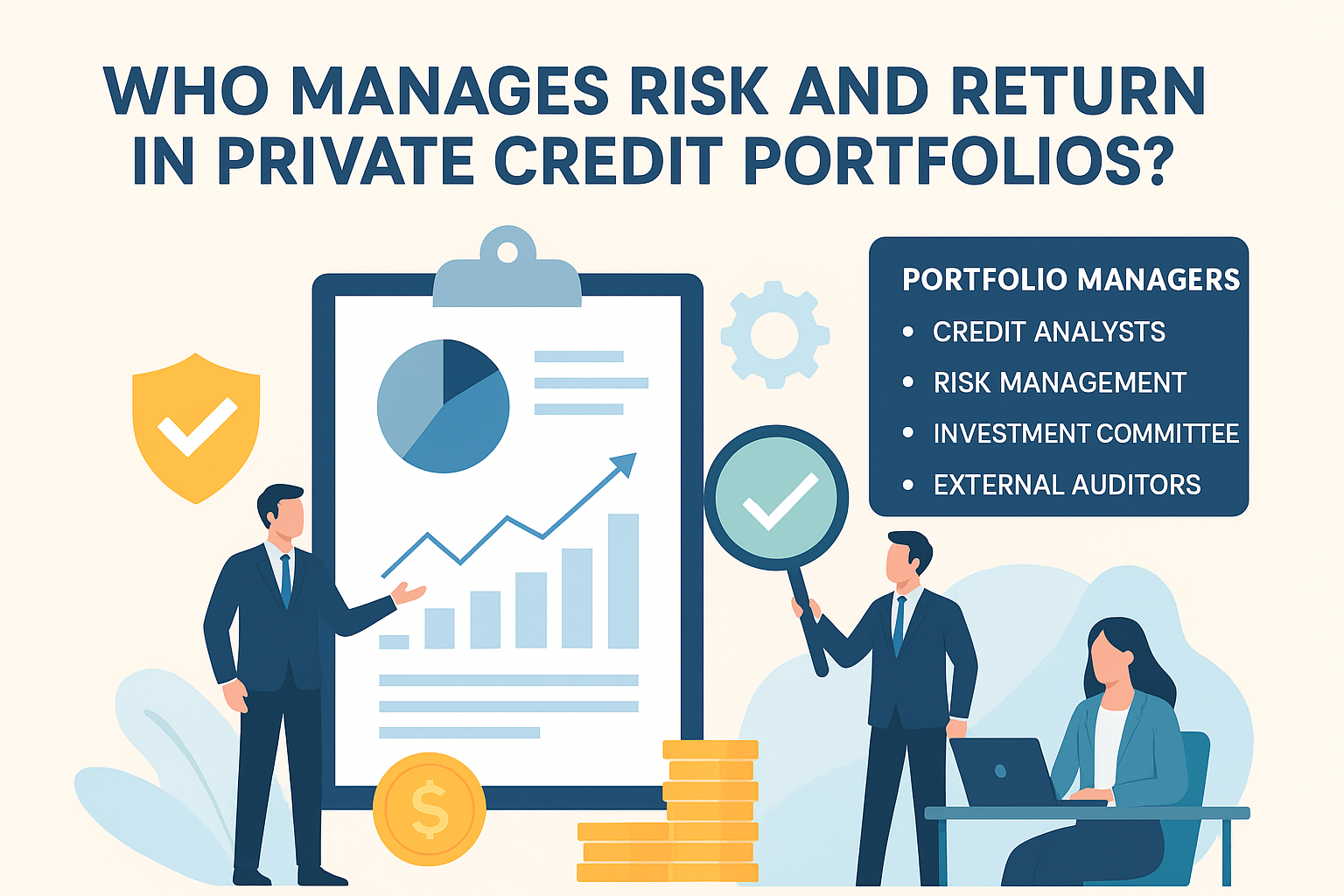
The responsibility of managing risk and return in private credit portfolios is typically shared among portfolio managers, credit analysts, risk management teams, investment committees, and external auditors. Together, they form a robust oversight framework that ensures loans and investments meet the fund’s underwriting standards while aligning with investor expectations. Portfolio managers lead the process, making strategic allocation decisions and selecting investments that best match the fund’s objectives. They evaluate market conditions, borrower quality, and diversification factors to strike the right balance between risk and return.
Meanwhile, credit analysts dig deeper into the financials of each borrower to assess repayment capacity, cash flows, debt structures, and potential weaknesses. Risk management teams monitor the portfolio continuously, ensuring compliance with internal risk limits, external regulations, and investor mandates. Investment committees—comprising senior professionals—review and approve major decisions. Together, these groups answer the critical question: who manages risk and return in private credit portfolios and how effectively they do it.
Role of Portfolio Managers in Private Credit
Portfolio managers are at the center of private credit investing, responsible for creating the portfolio strategy, selecting deals, and allocating capital across various borrowers and sectors. They evaluate macroeconomic trends, credit cycles, interest rate environments, and liquidity conditions before committing capital. Their goal is to deliver consistent returns while controlling downside risks. Since private credit loans are often illiquid, portfolio managers must carefully consider duration, leverage, and risk concentration.
In addition to investment selection, portfolio managers oversee ongoing portfolio performance. They work closely with analysts and risk teams to monitor loan payments, financial covenants, and borrower behavior. They also adjust strategies when markets shift, such as tightening underwriting standards during economic uncertainty or expanding allocations in favorable cycles. Ultimately, portfolio managers play a critical role in determining who manages risk and return in private credit portfolios, as their decisions directly influence performance.
Role of Credit Analysts in Managing Risk
Credit analysts form the analytical backbone of private credit risk management. Their primary job is to evaluate each borrower’s financial health through detailed assessments of revenue trends, profitability, leverage ratios, and cash flow stability. They also study industry dynamics, competitive positions, and future projections to determine whether a borrower has the capacity to repay. This underwriting process is essential for identifying both strengths and risks within a loan application.
After a loan is issued, credit analysts continue to monitor borrowers throughout the loan’s life cycle. They review financial statements, track covenant compliance, and identify early warning signs of potential distress. Their findings support portfolio managers in making informed decisions on restructuring, refinancing, or exiting positions. Without strong analytical support, the stability of returns in private credit would be compromised, highlighting the importance of credit analysts in determining who manages risk and return in private credit portfolios.
Risk Management Teams: The Guardians of Portfolio Stability
Risk management teams provide an independent layer of oversight to ensure the private credit portfolio stays within acceptable risk boundaries. They create and enforce risk policies, monitor market exposures, and track concentration risks across sectors, borrowers, and structures. Their work includes stress testing portfolios under various scenarios such as economic slowdown, interest rate spikes, or industry-specific downturns. These assessments help identify vulnerabilities long before they become financial problems.
Additionally, risk management teams collaborate with portfolio managers and analysts to ensure consistency in underwriting standards. They verify that each investment adheres to the fund’s risk appetite and regulatory requirements. By providing unbiased oversight, risk teams help strengthen the overall risk-return framework. This makes them essential contributors when evaluating who manages risk and return in private credit portfolios, as they act as the final checkpoint for safeguarding investor capital.
Investment Committees: Final Decision Makers
Investment committees are senior decision-making bodies that review major credit proposals before approval. Comprising experienced professionals such as chief investment officers, senior partners, and risk heads, these committees ensure that each investment aligns with the fund’s objectives. They evaluate the borrower’s financial condition, potential risks, expected returns, and structural protections such as covenants or collateral. Without investment committee approval, most private credit deals cannot proceed.
Beyond deal approval, investment committees also periodically review portfolio performance and adjust investment guidelines based on economic trends. During volatile periods, they may tighten credit criteria, reduce exposure to certain sectors, or increase diversification. Their oversight ensures accountability at the highest level, reinforcing their crucial role in managing risk and return in private credit portfolios.
External Auditors and Third-Party Oversight
While portfolio managers and internal teams play the primary role, external auditors and third-party consultants add an additional layer of transparency. Independent audits help verify whether valuations, financial reporting, and internal controls are accurate. This is especially important in private credit, where loans often lack a public market price and require fair-value estimation. Auditors ensure that these valuations follow accepted accounting standards.
Third-party consultants may also be brought in for specialized assessments such as industry risk studies, collateral evaluations, or operational due diligence. Their objective perspective helps identify blind spots internal teams may overlook. Although they do not make investment decisions, auditors and consultants contribute significantly to the ecosystem of who manages risk and return in private credit portfolios, supporting trust and accuracy in reporting.
How Technology Enhances Risk and Return Management
Modern private credit firms increasingly rely on technology to improve risk monitoring and decision-making. Advanced analytics tools, AI-driven credit models, and automated reporting systems allow teams to process vast amounts of financial data quickly and accurately. These tools help identify patterns, predict borrower behavior, and detect potential risks earlier than traditional methods.
Technology also supports real-time portfolio monitoring by tracking covenant breaches, payment delays, and market indicators. This enables faster response to risks and better alignment with return expectations. For many firms, technology has become an essential part of answering who manages risk and return in private credit portfolios, as it enhances human decision-making capabilities and reduces manual errors.
Factors Considered in Managing Risk and Return
Managing risk and return in private credit is a complex process involving multiple factors. Teams evaluate borrower creditworthiness, collateral value, covenant strength, leverage levels, and industry risks. Diversification plays a key role, as spreading investments across multiple sectors reduces exposure to concentrated risks. Interest rate environment, inflation, and economic cycles also influence return expectations and risk tolerance.
Another major factor is liquidity. Since private credit loans are not traded frequently, managers must consider how quickly they can exit a position if needed. Careful structuring of loan terms—such as interest rates, repayment schedules, and protective covenants—helps maintain a balanced risk-return profile. These combined considerations highlight why a coordinated effort among professionals is needed to determine who manages risk and return in private credit portfolios.
Conclusion: A Collective Effort Ensures Stability and Returns
In private credit investing, no single person manages risk and return—it is a collective effort involving portfolio managers, credit analysts, risk experts, investment committees, auditors, and technology systems. Each group plays a unique role, from underwriting and monitoring to oversight and compliance. Their combined expertise ensures that private credit portfolios deliver stable, predictable, and attractive returns while minimizing exposure to losses.
Understanding who manages risk and return in private credit portfolios is essential for investors looking to enter this asset class. With strong governance, disciplined underwriting, and continuous monitoring, private credit remains a highly attractive option for generating yield and diversification in modern investment portfolios.